Why enterprise AI strategy is becoming an allocation problem

For the past few months, my AI bill has come out of my own pocket. I have been building personal projects with AI coding agents, and I started at the top of the lineup: GPT-5.6 Sol at high reasoning effort. Each time rate limits caught me and the credits ran out, I stepped down the price-performance curve, first to Sol at medium effort, then to Luna, checking the benchmark data at every step against what my tasks actually needed. Luna at high effort turned out to be good enough for well-specified coding, and the spend became manageable. Then, on July 30, OpenAI cut Luna’s API price by 80 percent, to $0.20 per million input tokens and $1.20 per million output tokens, and my credit spend fell to a fraction of where it started.
Nothing about my work changed that week; the price of intelligence did. In OpenAI’s announcement, Michele Catasta, president of Replit, called Luna the closest we have come to “intelligence too cheap to meter.” One day later, DeepSeek released V4-Flash-0731, an update it attributes mostly to post-training on the same 284B-parameter architecture. Artificial Analysis scored it 50 on its Intelligence Index, one point below Luna at maximum reasoning effort, at an unchanged price of $0.14 per million input tokens and $0.28 per million output.
My credit bill is a rounding error. But the same repricing is hitting every enterprise AI budget at once, and it rewards at scale the same behavior it rewarded in me: asking how much useful intelligence a dollar buys, and where the expensive kind actually pays for itself.
“Too cheap to meter” has a history worth remembering. Lewis Strauss made the same promise about nuclear-powered electricity in 1954, and the phrase became shorthand for technological overpromising. Yet the underlying dynamic did play out with electricity in general: unit cost fell for decades and total spending grew anyway, because cheap electricity made thousands of new uses economical. I expect the same shape for machine intelligence. Unit prices will keep collapsing. Your AI bill will keep growing. Whether that spend creates value comes down to an allocation question: which intelligence, applied where, at what price, verified by what.
What the price curve actually says
Here is the current frontier, using Artificial Analysis Intelligence Index scores and list API prices:
| Model | Intelligence Index | Input / 1M tokens | Output / 1M tokens |
|---|---|---|---|
| DeepSeek V4 Flash 0731 | 50 | $0.14 | $0.28 |
| GPT-5.6 Luna | 51 | $0.20 | $1.20 |
| GPT-5.6 Sol | 59 | $5.00 | $30.00 |
| Claude Fable 5 | 60 | $10.00 | $50.00 |
The list-price spread between the bottom and top of this table is two orders of magnitude. Treat that number with care, in both directions.
The spread overstates the real cost gap on some workloads. Cost per task depends on how many tokens a model consumes to finish the job, and reasoning models can emit ten times the output of a model answering directly. A cheap model that reasons verbosely, fails, and retries can cost more per completed task than a premium model that succeeds on the first attempt. Artificial Analysis’s own cost-per-task measurements show the effect: priced per completed benchmark task rather than per token, Luna lands within a couple of cents of DeepSeek despite a four-times-higher output price, and the full spread from cheapest to most expensive narrows from about 180x to roughly 100x.
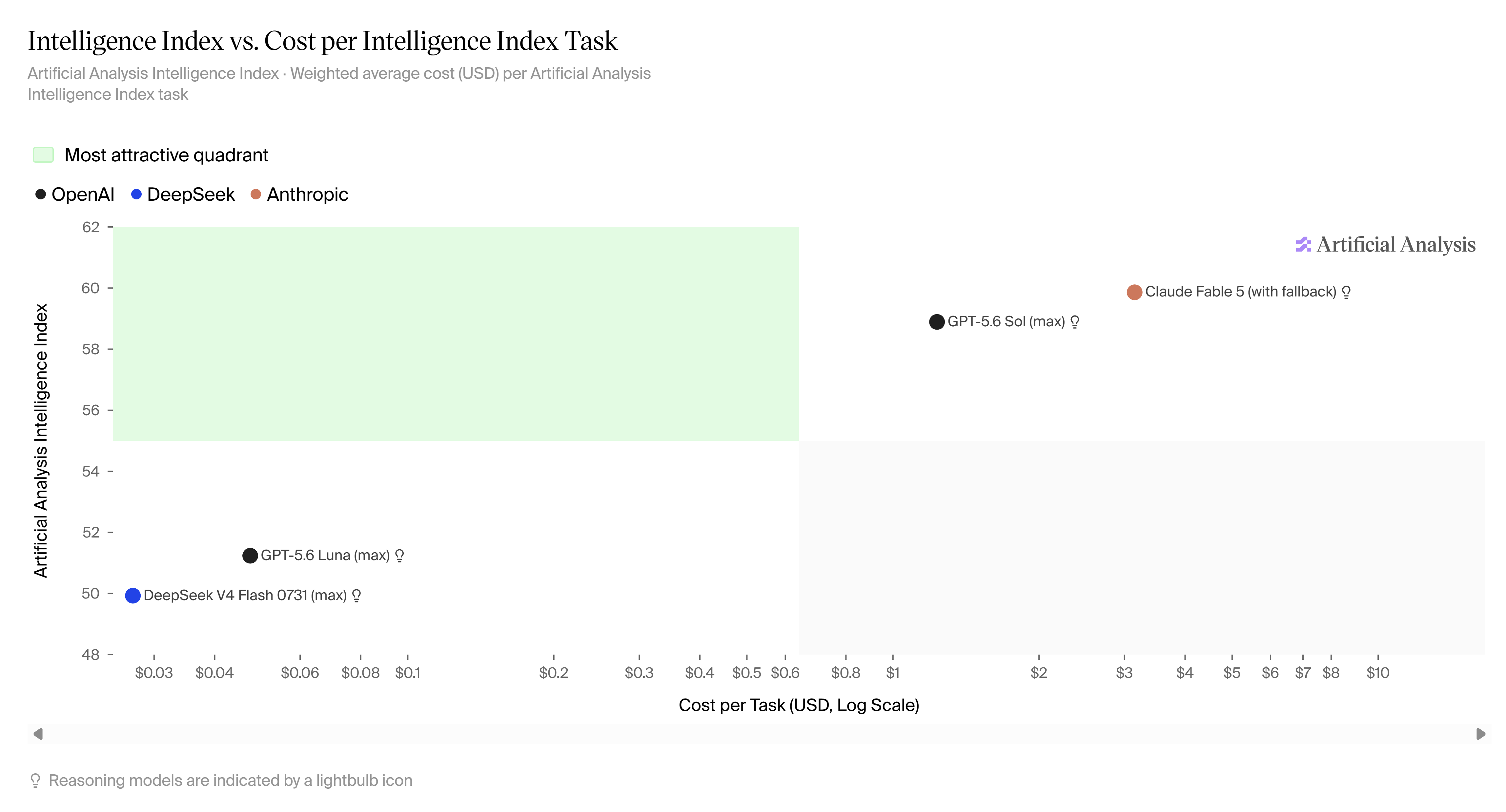
Source: Artificial Analysis, 3 August 2026.
The spread can also understate what the last ten index points are worth. Aggregate benchmarks compress capability into one number, and inexpensive models tend to score well on benchmarks while failing disproportionately on ambiguous, novel, or high-stakes work, which is exactly where enterprises concentrate their risk.
Both caveats point at the same conclusion. Price per token is the wrong unit of account. The metric that should govern AI spending is cost per successful business outcome at the required quality, latency, and risk level. Paying Fable prices for a task DeepSeek completes reliably is waste. Paying DeepSeek prices for a task where one bad answer costs a million dollars is a different kind of waste, with worse tail risk.
Cheaper intelligence, bigger bills
McKinsey found that AI spending grows nearly fourfold as organizations move from pilots to enterprise-wide deployment, and in its May 2026 survey 93 percent of respondents said they had exceeded their AI budgets. The same research found no broad retreat from AI; companies are trying to get the economics under control rather than pulling back.
The arithmetic of agents makes that growth easy to understand. A person using a chatbot sends a handful of requests. An agent resolving one ticket can read documents, query databases, call tools, run tests, inspect failures, and revise its own work through hundreds of model calls. When the unit price of a call drops 80 percent, the rational response is often to automate ten times more decisions, so the bill goes up. Falling prices raise, rather than lower, the return on managing consumption well. McKinsey estimates that disciplined AI consumption management alone recovers 20 to 30 percent of spend.
Allocation, illustrated
Consider a billing dispute, a workflow that costs many enterprises several dollars of human handling time per case; call it $8.
A naive AI design routes every dispute to the most capable model available and hopes. A mature design decomposes the workflow and prices each decision. A $0.14-per-million model classifies the dispute. Deterministic software retrieves the authoritative billing records at effectively zero marginal cost, because fetching a customer’s invoices is a database query, not a judgment call, and letting a model guess at data that can be looked up exactly is a liability.
An economical model investigates routine cases. Hard-coded business rules validate any proposed credit before it exists. Cases the cheap model flags as unusual escalate to a frontier model, and anything crossing a financial or regulatory threshold goes to a person.
With illustrative numbers: if the cheap tier resolves 80 percent of cases at a few cents each, the frontier tier handles 18 percent at a dollar or two, and humans take the last 2 percent, blended cost per resolved dispute lands around $0.60. The design decision that produced that outcome was never “which model is best.” It was deciding, step by step, what belongs to AI, what belongs to deterministic software, and what belongs to human judgment.
You cannot allocate what you cannot measure
Everything above depends on a capability most enterprises have not built: evaluation. Knowing that the cheap model resolves routine disputes at 98 percent accuracy, rather than believing it does, requires labeled test sets drawn from your real cases, run against every model you might route to, and re-run when models update underneath you. Without that, “use the cheapest model that works” is a slogan, because nobody can say what works.
Evaluation is the unglamorous prerequisite for every other idea in this article, and it is the most common gap between companies that talk about AI economics and companies that practice them.
Routing is becoming infrastructure
After the price drop, my own workflow stopped being a model choice and became a division of labor. Sol at medium reasoning reads the codebase, works out the structure, and writes the implementation plan. Before handing off, I have Sol account for what Luna can and cannot do, and flag any step in the plan Luna will likely find difficult, along with how to tackle it. Then Luna at high reasoning executes. I am acting as the routing layer by hand, and it is tedious, which is exactly why the market is turning this into infrastructure.
OpenAI’s own guidance for coding describes the same division of labor: Sol resolves ambiguity and writes the plan while Luna executes the well-specified implementation and testing. Cognition describes Luna as a pair programmer for larger models; Ramp made it the default for background automation. GitHub has gone further: Copilot’s Auto mode weighs reasoning complexity, debugging difficulty, tool-orchestration needs, and model availability before selecting a model for each task. GitHub offers paid customers a 10 percent discount for accepting automatic routing, because its evaluations show token savings without quality regression.
We already schedule compute, storage, and network capacity against workloads instead of hand-assigning servers. Intelligence is becoming the fourth schedulable resource.
You cannot buy portability
IBM surveyed 1,000 senior executives this June and found that 71 percent would find it difficult to change their primary AI vendor or model, and 91 percent said they do not fully understand their dependencies across AI vendors, models, and infrastructure. In a market where the price-performance leader changes quarterly, that is a business-continuity exposure. A company that can redirect suitable workloads to a newly cheaper model within days captures the savings. A company facing a six-month migration watches its competitors capture them.
The standard prescription is an AI gateway: a control plane between applications and model providers, where applications request a capability and the platform decides how to supply it based on quality, cost, latency, data sensitivity, and geography. That layer is worth building. It is also insufficient, and the vendors selling it rarely say so.
Prompts get tuned to a specific model’s behavior. Tool-calling conventions differ across providers. The real cost of switching lives in re-running your evaluation suites and fixing the regressions, which is one more reason evals are the foundation. Portability is an ongoing practice of abstraction plus measurement, sustained by architecture but never finished by it.
One design rule follows directly: own the context, not the conversation. Customer records, business rules, documents, workflow state, permissions, and evaluation datasets are organizational memory, and they should live in systems you control. Models should borrow that context at request time and hand it back. Luna consumes it today, DeepSeek tomorrow, something unreleased next year. The model should be replaceable. The state should not be.
Your architecture sets your ceiling
Google’s 2025 DORA research found 90 percent of respondents using AI at work and most reporting productivity gains, but the gains concentrated in teams with loosely coupled architectures, fast feedback loops, and strong internal platforms. Tightly coupled systems with slow processes saw far less benefit. AI amplifies the system it lands in. An agent given modular services, automated tests, CI/CD, and telemetry can act, observe, and correct itself. The same agent aimed at an undocumented monolith with manual deployments produces mistakes at machine speed.
This inverts a common instinct about modernization. When generating code approaches free, verifying code becomes the expensive step, which raises the value of everything that makes verification cheap: types, tests, explicit contracts, static analysis, observability, and clear module boundaries. It also changes the modernization math itself. If agents cut the cost of testing, documenting, and refactoring an existing Java estate, incrementally modernizing it often beats rewriting it in whatever language is fashionable. The goal is AI-legible systems: software explicit enough for machines and humans to reason about safely, in whatever stack it is already written.
Code is becoming abundant. Judgment about what to build, how to architect it, and whether it is actually correct is not, and abundant code makes that judgment more valuable rather than less.
Five questions before your next AI initiative
- What business outcome are we buying intelligence for, and what does success cost today?
- What is the least expensive intelligence that reliably meets the required quality, and how do we know?
- Which decisions belong to AI, which to deterministic software, and which to people?
- Could we change models, providers, or hosting without rebuilding the product, and when did we last test that?
- Are we measuring cost, quality, and risk at the level of the completed business outcome?
Raw access to strong models is available to anyone with an API key, which makes it a poor place to look for durable advantage. Strauss got the meter wrong but the direction right: when a resource gets cheap enough, the meter stops being the interesting instrument. What remains scarce is the organizational ability to allocate intelligence, meaning the evals that tell you what works, the routing that matches cost to task, the escalation paths to stronger models and to people, and the architecture that keeps every supplier replaceable.
Sources: OpenAI: Advancing the price-performance frontier with GPT-5.6 · DeepSeek API changelog · DeepSeek pricing · Artificial Analysis: DeepSeek V4 Flash 0731 vs GPT-5.6 Luna · McKinsey: The cost of intelligence · GitHub: Copilot auto model selection · IBM: The Calculus of AI Sovereignty · Google Cloud: 2025 DORA Report